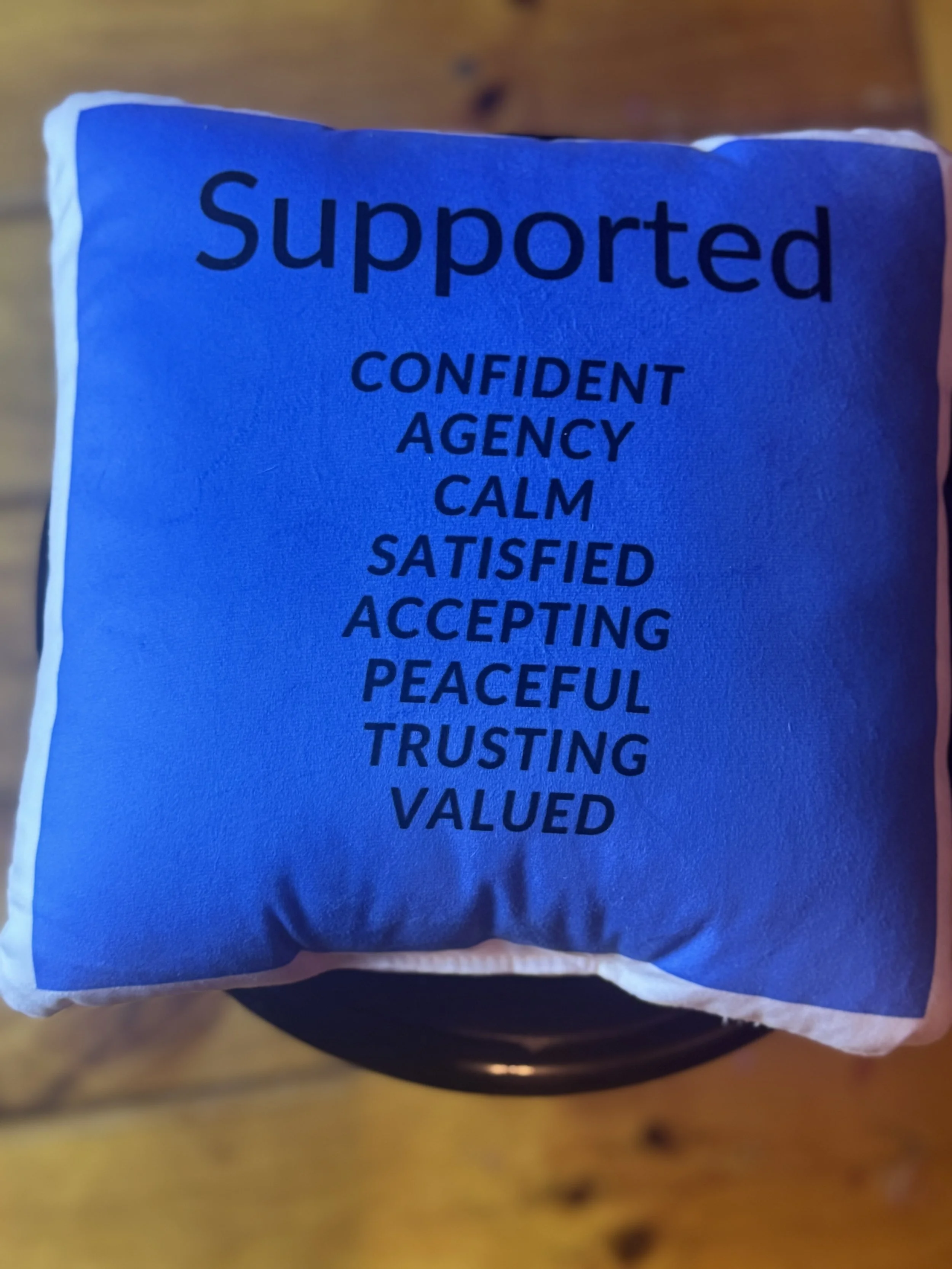
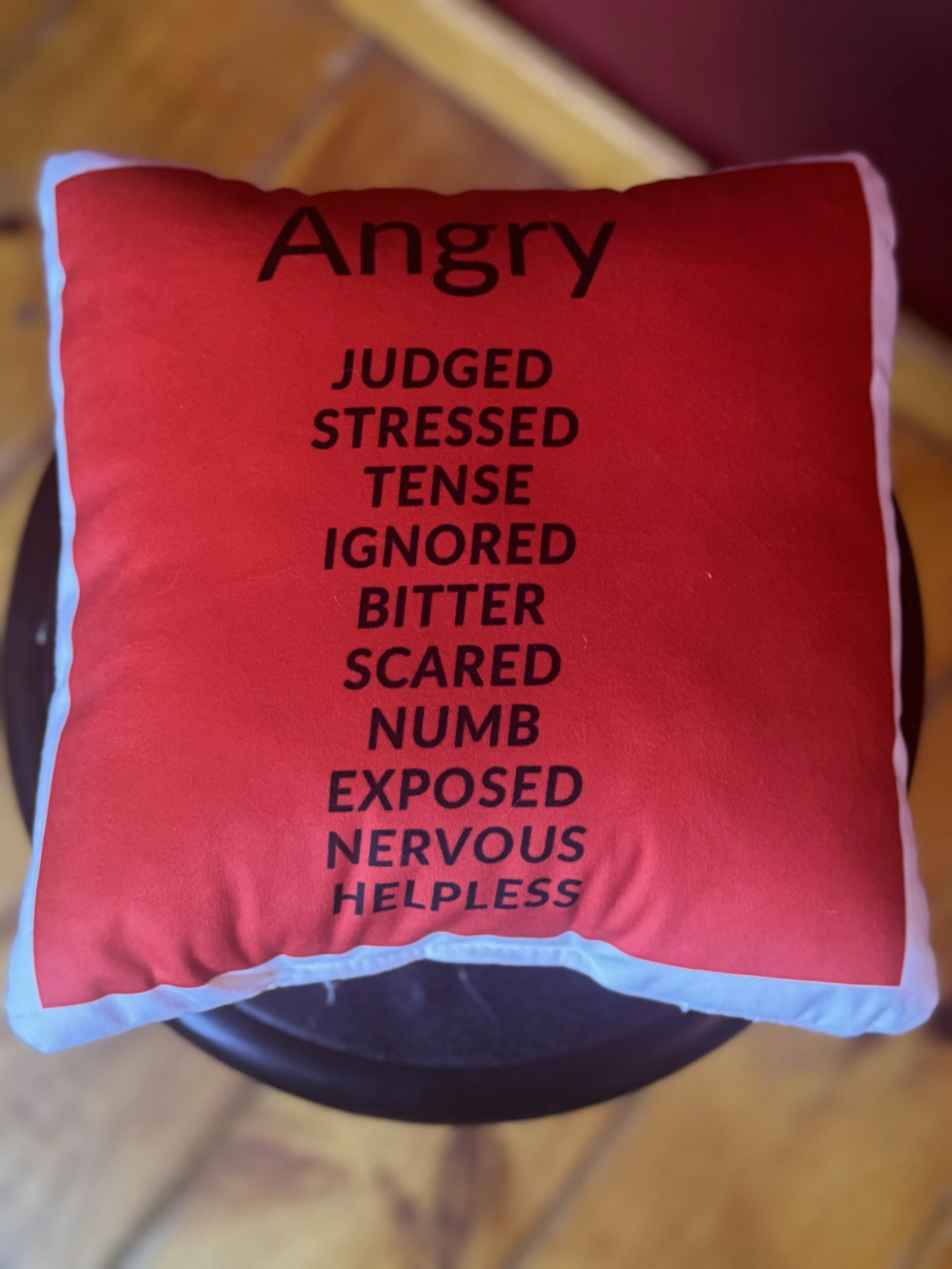
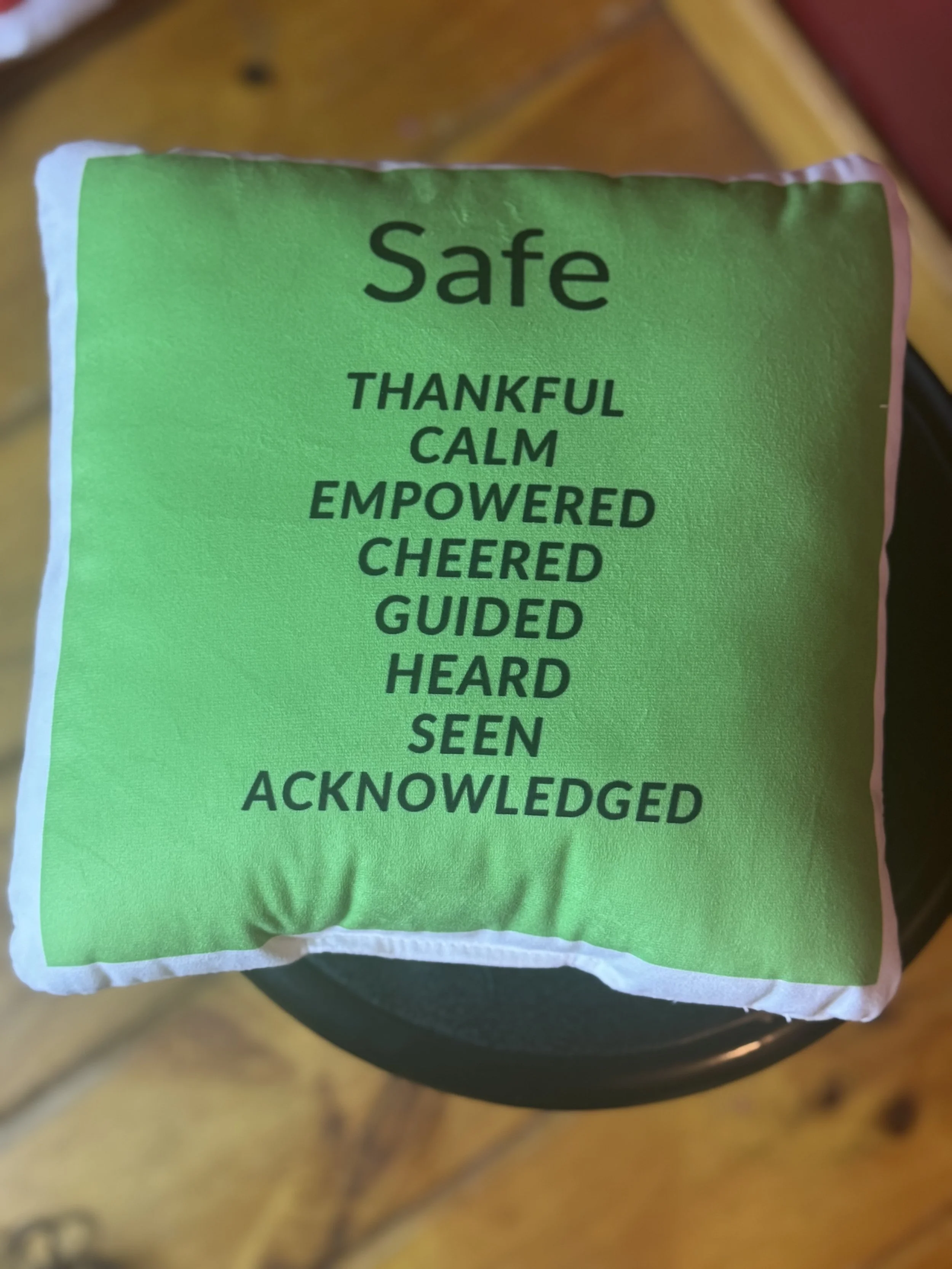
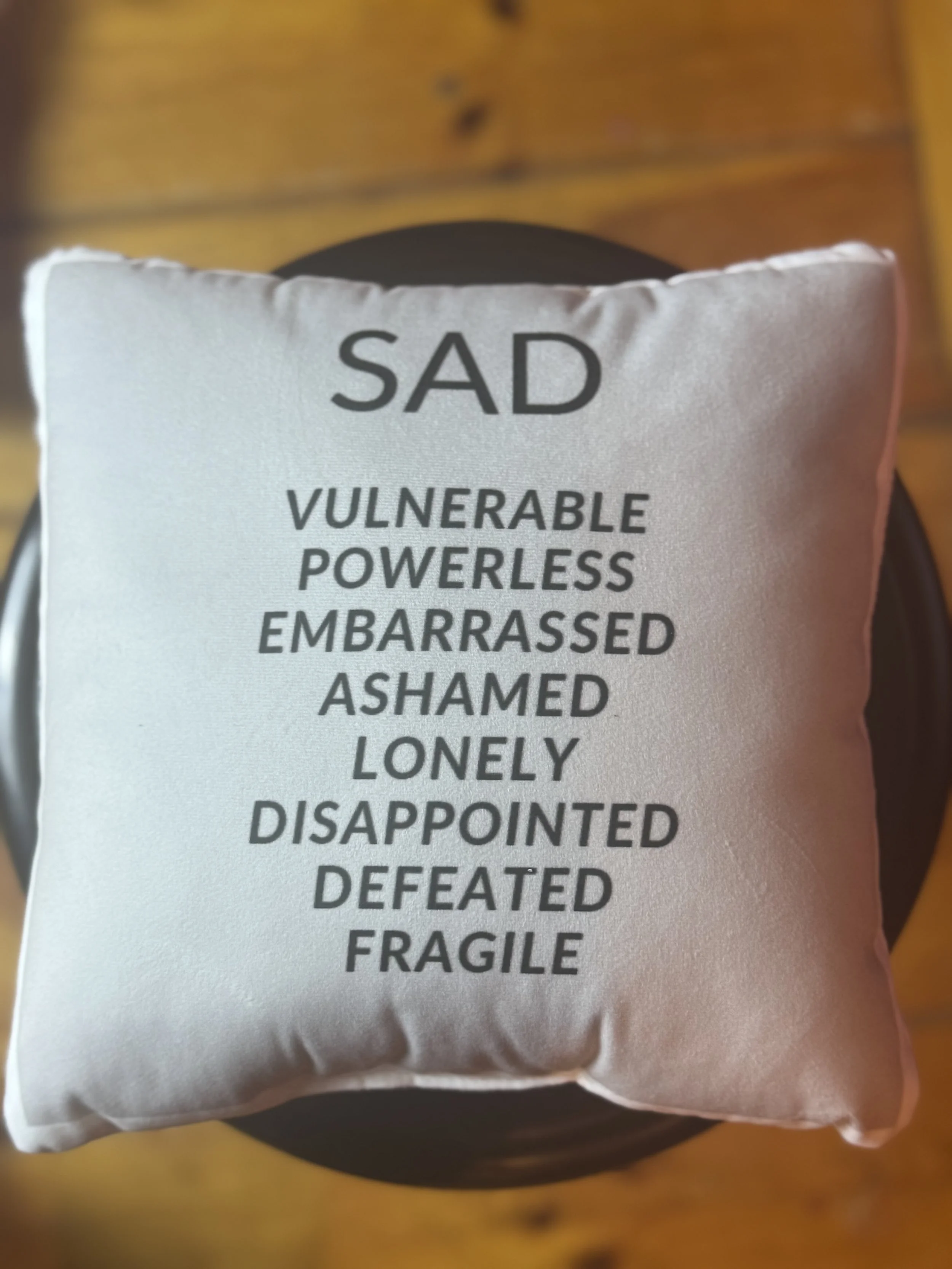
Example Design Day
Created to Explore Emotions and How They are Used for SP Work with the help of Emotion Pillows
The following is a potential design day outline, for a group of Standardized Participants, with video links further describing the games and ideas. My hope is that you can gather ideas for how you might utilize some of these games, or create your own games, using emotion pillows, to support the emotional work that SPs do both in feedback and portrayal. This work comes from my experiences in learning to facilitate groups on ropes courses, educational environments both in traditional and non-traditional classrooms, acting training and education, and years of working as a Simulated Participant.
In the following descriptions you can find a direct link to a video that you can click on or go through the gallery of videos on the right to watch the series of videos that describe various parts of the design.
You can learn a little bit about me here: https://youtu.be/gxsCx_3Bmgk
If you are new to the world of Simulated Participant work, here is a short video of how I describe the work: https://youtu.be/timoxSa72VM
My hope is that through these emotion pillows and utilizing them in the world of SP work, we can continue to find creative ways to build more empathic worlds and communication practices that support the work that SPs do. You can learn a little more of my ‘why’ behind these pillows here: https://youtu.be/i3z50rLKCn0 - Sarah Carleton
Pre-Day Work
Before the day of an event, the following are some things I have found helpful to gather to support a Design Day:
Video Link: Facilitation Tips https://youtu.be/ZM_TVeXvHcg
Things to Consider:
· Number of Participants
· Location of the workshop (open spaces that provide room to move are preferred)
· Accessibilities needs to be mindful of to support the whole group
· Participants experience in the world of SP work to know how to adjust vocabulary and level of the work
· Time frame for the work that day
· Understanding the learning goal for the group to help focus the design of the workshop
Materials Needed: emotion pillows, case, an open space to move in
Design Template for a 90 minute -2 Hour Workshop
Goal/Objective for the Day: To spend time exploring emotions and how they impact portrayal and feedback for SPs, through vocal and physical embodiment of emotions. Through play and exploration SPs can practice new ways to utilize emotions in their work as well as how to care for themselves as they dive into emotional cases and experiences.
Day of Intro and Establishing the Culture of the Day
Start with the group in a circle with everyone standing. (Adjustments can always be made to support the physical needs of the group to make it more accessible if need be.)
Video Link: Creating a Culture of Care https://youtu.be/mCq2L3fJj2A?si=EzmSnZA75Tzm7ge8
Some options for Intros: Have everyone introduce their names and offer an emotion describing how they are feeling in this moment.
Establish Safety/Learning Boundaries for the day: This can look a variety of ways depending on the time you have to work with the group. In the video overview, I suggest some ways you might approach this if you are interested in a more in-depth description. It can be as simple as setting expectations for the day and how we treat each other in the space, to more in-depth co-creating of a shared language of what it means to learn in a safe space.
Section 1 - One Minute Story Series
Video Description Link: One Minute Story Directions https://youtu.be/CcpYp5pdWpI?si=fE6lCvEKhedXayaF
Learning Goal: Focus on how we use vocal tools to convey and understand emotions.
Materials: emotion pillows, patient case, timer
Set Up: Partnered exercise
Part 1 – With a partner, face them, close enough that you can hear each other, and share a story about yourself for 1 full minute, at the same time. While speaking for a full minute, also work to recall 3 things your partner said. After the time is up, check to see if each of you recalled your 3 facts correctly about each other.
Part 2 – Switch partners and face your new partner, and in 30 seconds share an intro to your case in a neutral voice – trying to remove movement and vocal changes. Each participant shares their intro in a 30 second time, while their partner listens. (A simple case with a familiar setting to the work you do can be used for this.)
Part 3- Switch partners again and face your new partner. Before starting everyone comes to the center and views the pillows and chooses an emotion from a pillow. That emotion will be added to the intro they are sharing. Don’t share your emotion with your partner. Allow each person to share their intro with the added emotion and working to only bring changes to your voice, and keeping the body as still as possible. Once each person has gone there can be partnered reflections as well as group reflection on the experience.
Things to Reflect on: You can stop and reflect after each partnership or do one large reflection at the end. Keeping the focus on observable changes to the voice such as pacing, volume, intensity, how high or low the voice was. Questions to ask of the group to learn from each other: What did you notice about using only your voice to convey emotions? What did it feel like to try on a neutral voice? Did your choices, that you made in how to change your voice, communicate what you expected to your partner? How did your listening change between the three sections?
Section 2 - Exploring Emotions through Movement
Video Description: Moving with Emotions Link: https://youtu.be/rjpqDN_YlOI?si=0YvVVSMmzHiyKb5L
Learning goal: Explore how emotions change your own personal physicality and how your movements can be the same or different than others interpretations of emotions in the body.
Materials: emotion pillows
Set up: Place the pillows in the center of the space, the participants will be moving throughout an open space.
Movement Exercise: Before moving into adding emotions to your physicality, take time to discuss and move into a neutral body position. An acknowledgment, that our bodies are never completely neutral, and the exploration of what we add to our movement to create a portrayal, is helpful for us to explore so we can also choose to take it off after a case or add on to support a specific case. For help exploring a more neutral position, I might offer to participants, to stand with their feet underneath their hips, their spine elongated and long, hands at their sides, a deep breath filling the body and releasing tension that might be held in the body.
Following a discussion on neutral movement and body language, everyone is invited to move neutrally throughout the space. While moving, they are provided with directions for the next parts of the exercise.
The facilitator calls on a participant in the group, while everyone else continues to move, and has them go to the center and choose an emotion off a pillow and say it out loud to the group.
Once the emotion has been shared, the participant who chose the emotion, joins the group and everyone works to embody that emotion in their movements, moving from neutral to this emotion being shown on their body through observable physical changes.
This can be repeated with different participants and emotions for several rounds and then additional movement layers can be added such as:
Moving only in straight lines
Moving only in swirls and turns
Moving at your slowest pace
Moving at your fastest pace
And any combination of these with emotions also layered on to them.
While everyone is still having fun and there is energy in the room, end the game, and have everyone come to a circle and shake off the physical emotions they were carrying.
Things to Reflect on: These questions can be asked at the end or interspersed during the game, with a few moments where everyone freezes, and we stop and notice what folks are embodying or feeling in their body.
What specific things did you do with your body to convey the various emotions? What did you notice other folks doing in the group to represent that same emotion in their body? How did the pacing or style of movement impact how you moved in the emotion? How did taking on an emotion feel different than being in a neutral position? Are there ways that you have found that help you separate the emotions from a case from your own body? What do you do to shake off emotions physically from your body after a day of work?
Section 3 - Snapshot of an Emotion
Video Description Link: Snapshot of an Emotion https://youtu.be/Aj48yhBKe3I?si=E-itHrB_29BWcoMv
Learning Goal: Explore how an individual’s interpretation of an emotion is read by others. Asking the question, “Does the emotion I chose, show up in my body, the way I intended it to?”
Materials: emotion pillows
Set up:
Four smaller groups with each group having a pillow.
The group has about 5 minutes to come up with a snap shot – imagine you are creating a photo or painting - with each participant involved and embodying an emotion from the pillow their group has.
There should be a title to your freeze frame that the group agrees, on for instance - The Storm, A Forgotten Dream. The title should not include an emotion word.
Each participant chooses one of the emotions on the pillow, so that each participant has a different one. Everyone in the group should be included in the snapshot image with their emotion.
Once the 5 minutes are up, each group shares their snapshot, freezing and allowing the group to see their image. While the frozen group is sharing their image, the other groups get the chance to guess what the title might be, and what emotions they see based off of the observable things they see frozen in the image in front of them.
Things to reflect on: Did the title of their image surprise you? What observable things did you notice that folks did with their bodies? Did you notice yourself creating a story in your head about what you saw, and how was that assumption different than the observable physical moments you witnessed? Did the emotion you embodied create the response from the audience you anticipated?
Section 4 - Emotion Party
Video Link: Emotion Party https://youtu.be/j_-43lXP5l8?si=6hwLkM15aqgc-ABt
Learning Goal: To combine vocal and physical tools to embody and share an emotion. To notice the ways a group or room can change based on the emotions that are present in the room.
Materials: emotion pillows
Set up: 5 participants, 1 is the host of the party and the other 4 are attending the party with a gift of an emotion pillow. The rest of the participants can sit and view the party.
One at a time, the party goers enter the party with their present, an emotion pillow. As the facilitator you can help let the party goers know when to enter to keep the energy and flow going. Once the party goer has entered the room, they will present the host with the gift of a pillow and say “I present to you ___” whatever emotion they choose from that pillow. Once they have stated the emotion the host and everyone else in the room takes on that emotion. Through their physical interactions and vocal expressions and words, they convey the emotion without ever saying it again. This is repeated with the second party goer, and their new gift/emotion replaces the previous one, until all 4 pillows have entered the party. The hope is that there will be 4 different emotions embodied by a group, one right after another, watching the room shift based off of this.
The next step is for the attendees to leave. With the host finding a way to give back the emotion gifts, going to the last person to attend and moving through the party goers in reverse until the first one to enter is the last to leave. As each person leaves, their emotion also leaves the room, and the last emotion given is reverted to.
Depending on the group size, time for the workshop, and overall energy, this game can be done once, or you can split the group so that half goes first and the second half goes second. Possible ways to add folks to the party is to have folks come in pairs with a pillow/gift and a clear emotion they embody together.
Things to Reflect on: Following the game, ask those watching reflective questions to help them build their observational skills. How did people use their voice and body to convey the emotion they had gifted? What specific observable things did you see? Where there differences in the ways other party goers portrayed the same emotion? Where there similarities in ways that emotions were conveyed by people?
Conclusion
Video Link: Bringing the Day to a Close https://youtu.be/FKM9qj-MAJQ?si=_kDHn-13PvSNwnDj
Learning Goal: To create a connection between the start of the day, and reflect on how they are thinking about emotions at the end of the workshop.
Materials: emotion pillows
Set up: Have everyone in a circle in a standing position.
As the facilitator, you are part of the circle and start by saying the name of someone across from you in the circle, and then saying an emotion connected to the pillow you are going to toss to them. Remind everyone to remember who they tossed the pillow to. Each person in the circle will have the emotion tossed to them until the facilitator, is the last person to receive the pillow. Once this has been done, you start over, and this time add on a physical portrayal when you take the pillow. Once the first pillow has been passed around by a few folks add the second, then third, and finally the fourth pillow. It should be a little chaotic and a joyous moment of emotions and pillows and participants names being tossed around.
Things to Reflect on: What’s a take home point for you for the day? Is there anything that surprised you about today?
Conclusion: Have everyone gather again in a circle and share their name, an emotion from the day and where they feel that emotion in their body.
Then as a group take a collective breath in and out. Releasing the work of the day.
Additional Tools/Ideas:
Video Link: Additional Ideas https://youtu.be/CjP36auzNQE?si=AcImAXPo0rgscb7O
Emotion pillows, can also be used for smaller groups or work focused on case portrayal or feedback moments for a specific case that you are developing or portraying.